
Search Is Happening Everywhere — Just Not Where You Might Expect
It makes sense that when most businesses think about being found online, they still think about Google first. Google is still an important part of how people look for services, compare businesses, read reviews, and verify what they have heard elsewhere — especially when you think about how prominent Google Business Profile has become as an information source for AI platforms and other search engines.
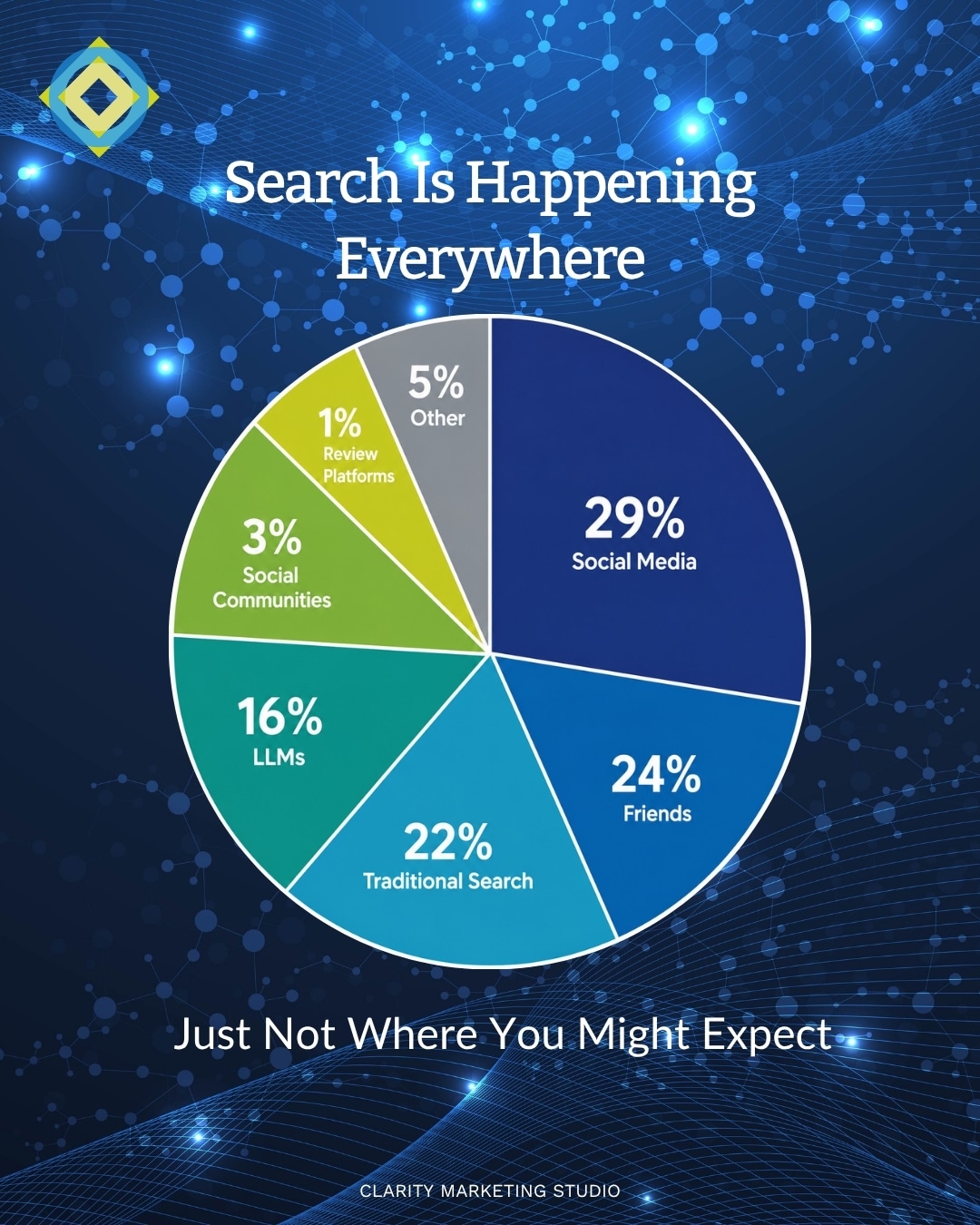
But Google is no longer where every search begins. Research published by NP Digital asked customers where they first discovered the brand they eventually chose. Social media led at 29%, followed by friends and word of mouth at 24%. Traditional search engines accounted for 22%, while AI tools like ChatGPT and Gemini represented 16%.
Granted, this was a relatively small survey involving 85 businesses, so the percentages can’t be used as universal benchmarks or assumed to apply equally across every industry. Still, the findings are a meaningful sign of the times. They reflect the broader shift we are already seeing.
People are discovering businesses through a mix of social media, personal recommendations, traditional search, and AI tools rather than one predictable path.
Their findings don’t suggest that Google is losing its value. They show that business discovery has expanded, and that people are moving between more sources before making a decision. It’s actually a much more web-like path.
Less Like a Funnel, More Like a Web
A customer’s path is rarely as simple as searching Google, clicking a website, and making contact. Someone may first notice a business in a social media post, hear the name again from a friend, and then search for it on Google. From there, they may visit the website, read reviews, look through recent social posts, and ask an AI tool to help compare their options.
The customer journey may cross several platforms and look like a collection of unrelated marketing activities. In reality, it is one connected decision process happening across several places.
In some ways, this brings us back to the original idea behind the World Wide Web. The web was never meant to be a straight path from Point A to Point B. It was designed as a connected network of information, with links leading people from one useful source to another.
The way people discover businesses now looks much the same. They may move from a social post to a Google search, from a review to a website, or from an AI-generated answer to several other sources before making a decision. The path is less like a funnel and more like a web, with each point of contact helping people find, understand, and verify the business from a different direction.
Each source answers a different question. Social media may introduce the business. Google may confirm that it is local and established. Reviews provide reassurance. The website explains the services in more detail. AI may bring information from several of those sources together into one answer.
The business needs to make sense wherever someone encounters it.
Social Media Is Becoming Part of Search
Social media was the largest source of first discovery in the study. That doesn’t mean every business needs to post constantly or maintain a presence on every platform. It does mean social content can plant a seed and help a business become familiar before a customer is ready to act.
A homeowner may notice a real estate agent through a neighborhood market update. A prospective renter may discover an apartment community through a floor plan or amenity post. A traveler may save an RV park post months before planning a trip.
Social media is not separate from search anymore. It’s one of the places where discovery begins.
In each case, social media creates an early point of contact. When the need becomes more immediate, the person already recognizes the business and has a reason to look further.
Social content can’t stand alone for that reason. But a useful post can lead to a permanent page on the business’s own website that tells the whole story, where someone can find more complete information and continue the decision process.
Word of Mouth Still Needs Something to Back It Up
Personal recommendations accounted for almost one-quarter of first discoveries in the study. Trust still carries enormous weight, especially when people are making decisions about housing, property, and travel.
A personal recommendation is usually the beginning of the research, not the end.
After hearing about a business, people often look for a professional website, accurate contact information, recent reviews, useful content, and signs that the company is active and credible. They want the information they find online to support what they were told.
Word of mouth may put a business on the list, but its online presence helps determine whether it stays there.
Google Still Holds the Pieces Together
Traditional search engines accounted for 22% of first discovery in the study, but that number doesn’t capture Google’s full role in the customer journey.
Even when people first hear about a business somewhere else, Google is often where they go to investigate it. They use Google Search and Maps to confirm the location, read reviews, see photos, find the website, and compare nearby options.
Google may not always be where people first discover a business, but it is often where they decide whether the business is worth considering.
That makes a well-managed Google Business Profile and a technically sound website as important as ever. They are two of the most essential parts of a business’s online presence, which is why Google Business Profile management is included in our Foundation Visibility Framework℠. Your website gives people a reliable source of complete information, while your Google Business Profile helps them find, verify, and connect with your business through Google Search and Maps.
AI Is Already Part of Business Discovery
The study found that 16% of customers first discovered a brand through an AI tool such as ChatGPT or Gemini. That is not a prediction about where search may be heading. It is evidence of how people are already looking for information.
Someone may ask an AI tool to recommend a local real estate agent, identify apartment communities with specific features, suggest an RV park for an upcoming trip, or compare service providers in an area.
AI tools form their answers using information available across the web. That may include websites, business profiles, reviews, articles, social content, directory listings, and mentions on other trusted sites.
AI search is not replacing the rest of your online presence. It is drawing from it.
There is no single AI optimization trick that makes a business visible. AI discoverability grows from the same things that have always supported a strong online presence: clear information, useful content, consistent branding and business details, credible third-party signals, and a website that explains the business well.
Reviews Don’t Start the Search, But They Help Shape the Decision
Review platforms represented only a small share of first discovery in the study. That does not mean reviews have become less important. It simply means they often play a different role.
People may discover a business through social media, a recommendation, Google, or an AI tool and then turn to reviews before making contact. Reviews help them decide whether the business appears dependable, responsive, and capable of delivering what it promises.
Reviews may not be how people first find your business, but they strongly influence whether they decide to choose it.
For high-trust decisions like housing and hospitality purchases, rentals, or reservations, that confirmation can be especially important.
Discovery helps a business get noticed. Reviews help people feel comfortable taking the next step.
This Is Why We Practice Search Everywhere
At Clarity Marketing Studio, we use a Search Everywhere approach for our clients because we know search has changed for good. Customers searching for solutions have more options than ever before.
They may search through Google, social media, maps, reviews, referrals, websites, and AI tools—often using several of them during the same decision.
Search Everywhere is not about appearing on every platform, chasing every new marketing trend, or flooding the internet with automated AI content trying to be seen. It is about methodically building a clear, useful presence across the places that influence how people find, understand, and evaluate a business.
Search Everywhere does not mean being everywhere. It means being easy to find wherever the search begins.
The website remains at the center of that work. It is the one place the business controls and the most complete source of information about who it serves, what it offers, and why someone should choose it.
The surrounding channels help people discover and verify that information.
The Foundation Visibility Framework℠ Keeps the Pieces Connected
Our Foundation Visibility Framework gives structure to the Search Everywhere practice. It brings together five areas that support how a business is found, understood, and trusted:
- Performance
provides a fast, secure, technically reliable website that people, search engines, and AI tools can access and understand. - Engagement and Liability Protection
supports confidence through reviews, social content, accessibility tools; provides protection with current ADA and privacy policy coverage. - Google Business Profile Management
strengthens local visibility in Google Search and Maps, enabling AI discovery and keeping important business information accurate. - Fresh Website and Social Content
gives people more ways to discover the business and gives search and AI systems more context about its services, expertise, and relevance. - Authority Building
reinforces credibility through consistent business listings, trusted mentions, and quality links from other websites.
These elements aren’t separate items on a marketing checklist. They work together.
A social post may create the first introduction. Google may help someone verify the business. Reviews may build confidence. The website may answer the questions that matter most. Trusted mentions and consistent information help search engines and AI systems confirm that the business is credible.
That is what a connected visibility system is designed to do for our three focus industries. Take a look at the customized framework for each one:
People Are Still Searching—the Places Just Changed
Contrary to the more dramatic predictions circulating online, search is not disappearing. SEO is not dead. People still need to find information, compare options, and decide which businesses they can trust. What is changing is where they search, how they ask questions, and how many sources they use before making a decision.
Traditional search is not going away, and a strong website is not becoming less important. In many ways, it is becoming more important because it gives every other part of the online presence a reliable place to lead.
What has changed is the number of places involved in discovery and decision-making.
People may first encounter a business through social media, a recommendation, Google, or an AI-generated answer. Wherever the search begins, they should find the same clear, useful, and trustworthy business.
That is the purpose of a Search Everywhere approach, and why the Foundation Visibility Framework℠ connects the website, Google Business Profile, content, engagement, and authority instead of treating them as separate marketing activities.
Visibility today is not about ranking in one place. It is about being easy to find, understand, and trust throughout the entire search.
About the Author: Linda Phillips Blue
