You post the listing, share the photos, announce the open house, and celebrate when it sells. Then you start again with the next property.
That work matters. Your seller hired you to help bring the right buyers to their home.
But somewhere in all that activity, there’s another business that needs your attention: yours.
When someone looks you up, do they get to know the agent behind the listings?
Can they tell where you work, how you help, and why they might feel comfortable calling you?
Effective real estate agent marketing needs to answer those questions. A home can attract attention for a few weeks. Your own reputation needs to keep working between listings, through slower months, and when someone finally decides they’re ready to move.
Marketing a Property and Marketing Yourself Are Two Different Jobs
A property campaign helps someone decide whether to look at a particular home. Your own marketing helps them decide whether to work with you. Those decisions overlap, but they aren’t interchangeable.
Beautiful photography might make someone save a listing. A thoughtful explanation of how you help sellers prepare may give them a reason to ask you about their own home.
Think about the difference:
Property marketing answers: What is this home like? What does it cost? When can I see it?
Agent marketing answers: Does this person understand my situation? How would they help me? Can I trust them with this decision?
You need both. The problem comes when every post is about a property and very little explains the person and service behind it.
A “Just Sold” post tells people a transaction closed. But it doesn’t provide any lasting impression about how you handled that transaction. With permission and appropriate privacy, an explanation of a challenge you helped resolve can show them what you actually contributed.
Your Brokerage Profile Page Is Only an Intro
If your broker gives you a page on the company website, keep it accurate and use it. It can confirm your affiliation, display your contact information with a link to your website, and help someone find you by name. If your brokerages provides individual agent websites, content support, and direct inquiry routing, all the better. But…
A basic profile page on a brokerage website has a very limited job. It introduces you as a supporting player in their business marketing.
The company website typically does the job of marketing the brokerage — not necessarily helping their agents. It presents the brokerage’s listings, service areas, team, and overall reputation. Their agent directory serves to bolster their own company reputation, to help a visitor choose someone within that company as their agent, but without giving each agent a strong, distinct presence of their own.
These profiles on brokerage websites provide your contact info and possibly a short biography, but they give people relatively little room to understand your particular knowledge or how you work. And if the site’s main navigation leads visitors back to the company, other agents, and general inquiry forms, the experience keeps centering the brokerage.
That isn’t a criticism of the broker! It reflects what a company website is there to do.
A Listing on a Website Is Not Active Promotion
A brokerage website can perform well in search while individual agent pages receive little relevant attention. The company’s visibility doesn’t automatically become equal visibility for everyone in its directory.
Most brokerages don’t invest in SEO to promote their individual agents, because that isn’t their primary mission.
That doesn’t mean Google refuses to rank agent pages on brokerage domains. An agent’s page on a brokerage website can appear in Google search results. But simply being listed on a successful brokerage website doesn’t guarantee that people searching for an agent in your market will find you. Your individual page needs useful content, relevant links, and proper search optimization to build visibility of its own.
The practical question is whether your broker’s page is doing enough for your business.
- Can you publish your own useful articles there?
- Explain your buyer and seller services in detail?
- See how visitors find you?
- Make sure inquiries reach you directly?
- Keep your content and contact information accessible if you change brokerages, subject to your agreements?
Ask those questions before assuming that having an agent page means your online marketing is taken care of.
Give People a Place to Get to Know You
Your own website gives you room to organize the information around the people you want to help.
It can explain your approach to buying and selling, answer common questions, show your own reviews, and make the next step clear. It also gives your email, social posts, referrals, and business profiles a consistent foundational destination.
You don’t need a huge site to begin. But you do need a strategy with more than a headshot and a promise to provide excellent service.
Show people what that service looks like.
- For sellers, that might mean explaining how you help decide what to repair before listing, how you discuss pricing, and how you keep them informed.
- For buyers, it might mean explaining how you compare properties, prepare for a search, and help them understand their choices.
If you build a separate site, be clear about who controls the domain, content, accounts, and inquiries. Your brokerage affiliation should remain clear, and your broker should review the site for applicable advertising requirements.
Keep Property Searchers on Your Site with IDX
Your website can introduce you and give people something practical to do while they’re there. An added IDX property search lets visitors explore MLS listings available in your market, not just the properties you represent.
Someone might arrive on your site through an article about buying a home, then start looking at available properties. With a good IDX solution, they can filter searches, save favorite homes, receive new listing alerts, and contact you about properties that interest them. Those features give visitors reasons to explore your website and come back.
At Real Estate Marketing Studio, we use iHomefinder IDX technology to bring MLS property searches directly into your own website. Visitors can explore available properties without leaving your website, see your MLS listings and sold properties labeled with your own branding to highlight your accomplishments, and use the integrated lead management tools to help them stay connected.
Your Identity Front and Center
Just as important, a good IDX solution keeps your identity front and center. Property listings appear within your own branded website, with your name, contact information, and opportunities to connect with you throughout the search experience. Although MLS rules still require proper identification of listing brokerages, your branding helps visitors recognize you as the agent who can assist them.
Compare that with sending visitors to Zillow or another large real estate portal. Once they leave your website, they’re surrounded by listings, advertisements, and opportunities to contact other agents. It’s easy for someone who started with you to get lost among all those competing choices.
Keeping property searches on your own website gives buyers a more direct connection to you. They can explore homes while learning about your services, reading local market advice, and getting comfortable with you as the person to call when they’re ready for help.
Our Foundation℠ IDX Website System is designed around this connection. It combines your individual branding with native-domain MLS search, property pages, lead capture, and an iHomefinder mobile CRM that helps you manage inquiries and follow up with interested buyers.
IDX Is an Engagement Tool
IDX property searches give visitors something useful to do on your website. Instead of reading one page and leaving, they can explore listings, compare homes, save searches, and return when new properties become available.
That additional engagement can be valuable, but it’s important to understand the distinction: Google doesn’t automatically rank a website higher simply because visitors spend more time browsing its pages. The real benefit is giving potential clients a useful experience that encourages them to return and eventually contact you.
IDX doesn’t attract traffic on its own; your content, local search visibility, social media, and other marketing bring people to your website. Engaging website features keep them interested.
That’s why Real Estate Marketing Studio combines IDX technology with ongoing website and visibility services. We handle the website, branding, and search optimization, while iHomefinder provides the property search and lead management technology. Together, they help you attract visitors, keep them engaged with your own business, and give them more reasons to choose you when they’re ready to make a move.
Maintain a Consistent Online Identity
Your Cumulative Online Reputation
Your online identity isn’t limited to your website. It’s the cumulative impression people get from everywhere they find you online. That includes your brokerage page, Google Business Profile, social media, reviews, and other professional listings.
Consistent branding across all these places helps people recognize, remember, and trust you.
Your professional name, photo, contact information, service areas, and description of what you do should tell the same story wherever someone finds you. When those details are inconsistent or outdated, they can create confusion and make it harder for potential clients to connect the dots.
Consistency Matters for SEO
Consistency also matters for search visibility. Google and AI-powered search tools gather information from multiple online sources to understand businesses and professionals. When your information is accurate and consistent across the web, it helps reinforce your identity and gives search systems clearer information to work with.
A good SEO provider understands that optimizing your website is only part of the job.
At Real Estate Marketing Studio, we pay attention to how your business is represented elsewhere online, including your Google Business Profile, professional directories, social media profiles, and other relevant sources. Keeping these connected and consistent is an important part of building long-term visibility.
For eligible individual real estate agents, a properly maintained Google Business Profile is especially valuable because it can help people find you in local searches, read reviews, and contact you directly.
The goal is to make you recognizable wherever people encounter your business. Whether someone finds a property listing, reads your blog, sees a social media post, or searches for your name, they should come away with a clear, consistent impression of who you are and why they might choose you.
Share the Knowledge Behind the Listings
You know a lot more about real estate than what’s currently for sale. Why not put that knowledge to work for you?
Think about the questions buyers and sellers ask you every day.
- Is now a good time to sell? Which improvements are worth making before listing?
- What should buyers know about today’s market?
- These are opportunities to share your experience and help people get to know you before they ever pick up the phone.
Your blog gives you a place to answer those questions in your own voice. Share what you’re seeing in the local market, explain what the numbers really mean, and offer practical advice based on your experience.
That’s the kind of information that helps someone think, “This agent knows what they’re talking about.”
And you don’t need a new listing or a recent sale to have something worth saying. You’re out there touring homes, talking with other professionals, watching market trends, and learning things that buyers and sellers would find useful. Share those observations, and be clear about what’s based on your own experience.
There’s a search benefit, too. Google favors helpful, original content created for people rather than articles written simply to attract clicks. AI-powered search tools may also discover and reference useful information from your website. Neither rewards posting just for the sake of posting, and neither guarantees visibility.
The point isn’t to become a full-time blogger, or an influencer documenting your every move. It’s to let people see the knowledge, judgment, and experience you bring to your work.
Your listings show people the properties you represent. Your blog helps them understand why they might want you to represent them.
One Good Idea, More Ways to Be Found
You don’t have to come up with something completely new every time you post on social media or send an email. One good idea can go a long way when you share it in different ways.
Let’s say you’ve written a blog post about getting a home ready to sell. You could turn the main points into a few social media posts, make a short video with your favorite tip, or share the article in an email to past clients. Each one gives people another opportunity to benefit from your knowledge and remember who you are.
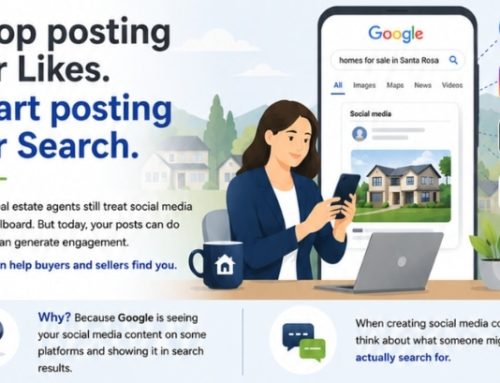
And don’t forget that your social media content can do more than reach your followers. Public posts can also appear in Google search results and may be discovered or referenced by AI-powered search tools. That gives your expertise more opportunities to be found beyond your immediate network.
The important thing is to connect the dots. Your website, blog, social media, Google Business Profile, and email communications should all reinforce the same professional identity and give people easy ways to learn more about you.
You don’t have to turn every post into a sales pitch, either. Share something useful, offer a little perspective, or answer a question people are asking.
The more often people encounter helpful information from you, the more familiar you become. And when they’re ready to buy or sell, you want to be the agent who comes to mind.
Stay Connected To Be the Agent they Remember
Real estate has always been a relationship business.
Your website and online marketing help people find you and get to know you, but it’s the personal connection that turns interest into trust.
Don’t wait for someone to announce they’re ready to buy or sell. Stay in touch with past clients, share useful information, and keep building relationships in your community. A quick check-in, a thoughtful answer to a question, or a helpful market update can mean more than another “Just Listed” post.
And when someone does reach out, be ready to respond. You can have a beautiful website, great search visibility, and plenty of social media activity, but none of that replaces a timely, personal conversation.
Pay attention to what your marketing is actually accomplishing. Likes, shares, and website visits are encouraging, but they’re not the whole story. Are more people contacting you directly? Are past clients referring their friends? Are conversations turning into appointments and new clients?
That’s where your marketing efforts begin to pay off.
The goal isn’t simply to get more attention online. It’s to become the agent people remember, trust, and choose when they’re ready to make a move.
A few questions agents often ask
Is a brokerage profile page enough to get started?
It can be, especially if it includes useful information about you, direct contact options, and opportunities for people to learn more about your services. But remember, your brokerage’s website is primarily there to promote the brokerage, not your individual business.
Where should I start to build a reputation online?
If you’re ready to establish your own online identity without a big investment, a simple one-page Foundation℠ website from Real Estate Marketing Studio is an affordable place to start. It gives you a professional website with your own branding and room to grow as your business develops.
Can property listing posts help promote me as an agent?
Yes. They can demonstrate your presentation and marketing work. And if properly formatted they can attract search traffic. If you add context about your contribution when appropriate, people learn something about your service as well as the property.
How frequently do I need to post new information online?
There’s no magic number. What matters most is sharing useful, relevant information consistently, whether that’s a new blog article, a social media post, or an update to your Google Business Profile. Fresh content gives people more opportunities to discover you and helps keep your online presence current. Choose a schedule you can maintain, and focus on quality rather than quantity. You don’t need to post every day to build visibility and trust.
What content should I post and where?
Start with information that helps buyers and sellers make decisions. Share local market insights, answer common questions, offer practical advice, and show people the experience you bring to your work.
Your website, blog, social media, and Google Business Profile should work together, with content tailored to each platform. There’s a strategy behind choosing what to publish, where to share it, and how to optimize it for traditional and AI-powered search.
What if I can’t manage all that myself?
Real Estate Marketing Studio’s Elevate level membership takes care of it for you, including personalized blog content, social media posts, Google Business Profile updates, and ongoing search optimization on and off your website. You can focus on your clients while we keep your online presence active and working for you.
Build recognition that lasts beyond the next listing
Your listings deserve good marketing. But so does the business you’re working to build.
Give people a clear picture of who you are, what you know, and how you help. Let your brokerage page support that picture, and make sure the rest of your online presence gives them enough information to choose you.
At Real Estate Marketing Studio, we help agents bring those pieces together with a practical website and ongoing visibility support that follows the latest trends in search, AI strategies, and site visitor behavior, supported by our in-house team.
If your marketing shows plenty of properties but very little of you, let’s talk about how to change that.