
A property manager has three apartments opening up next month. She could mail postcards to every renter within five miles. Or she could make sure her community shows up when someone searches online for “pet-friendly apartments near me.”
Which one is the better use of her budget?
That’s the inbound vs. outbound question. Every business owner faces some version of it:
Are you building something that keeps bringing in customers, or paying for ads and mailers that stop working as soon as you stop paying for them?
We’ve been helping service businesses get found online since 1999. Our honest answer is that both can pay off. What matters is your return on investment (ROI), meaning how much business your marketing brings in compared with what you spend.
Inbound vs. Outbound Marketing: The Quick Answer
Neither one wins for every business.
- Inbound marketing makes you easier to find and lets people get comfortable with you before they reach out.
- Outbound marketing puts you in front of people who might never have found you on their own.
The right choice is whichever one brings you more good customers for the money. The only way to know is to measure your own results.
What’s the Difference Between Inbound and Outbound Marketing?
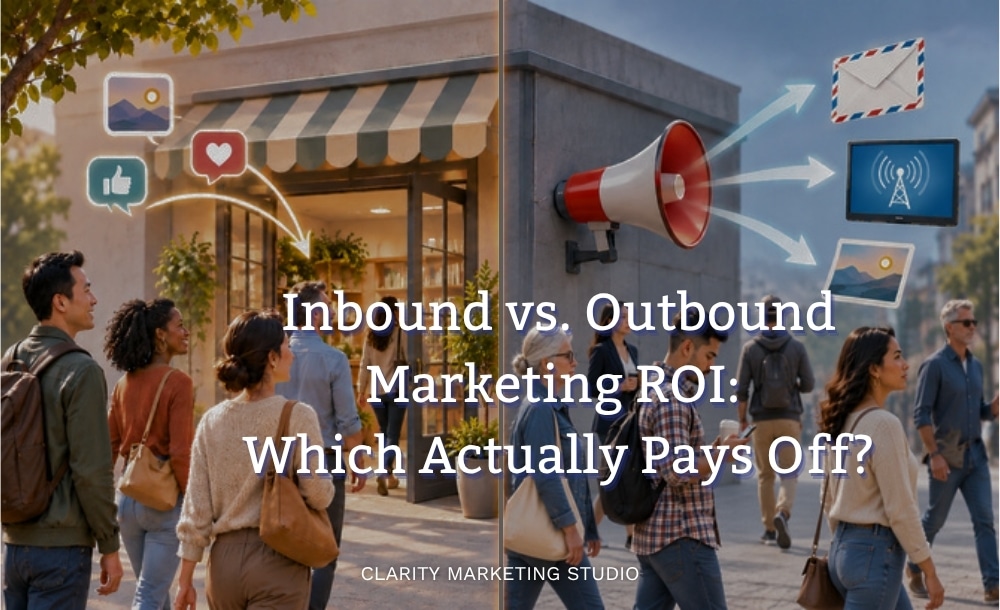
Inbound brings customers to you. Outbound takes your message to them.
It’s a lot like farming and hunting. Inbound is the farmer: you plant and tend, and the harvest keeps coming season after season. Outbound is the hunter: you go out and bring something home quickly, but tomorrow you hunt again. Most businesses do best with a little of both.
Both go by other names, which can make marketing conversations complicated. Here’s what you’re likely to hear.
Inbound Marketing
Inbound marketing reaches people when they’re already looking for what you offer.
It’s often called pull marketing, because it draws people toward you. You may also hear it called organic, attraction, or permission marketing.
It works the way you probably shop for a business yourself. You search Google, ask ChatGPT, read reviews, or ask a friend. The businesses with clear, helpful information show up. You check their website, look at photos and reviews, and decide who to call.
Your customers have more ways to do that research than ever before. They can compare options, read what other customers say, and ask an AI tool for recommendations, all before they pick up the phone. That puts them in control. They’re looking for the business that’s the best fit for them, and they’re choosing from the ones that show up with clear, honest information.
Inbound marketing includes:
- Your website
- Search engine optimization (SEO)
- Your Google Business Profile
- Customer reviews
- Helpful articles and social media posts
For an apartment community, that might be a neighborhood guide or a clear pet policy page. For an RV park, it’s spelling out site sizes, hookups, and nearby attractions. For a real estate agent, it’s a local market update or a buyer success story. For a builder, it’s a gallery of finished projects.
Inbound takes patience. A new page can take months to show up in search. But once it does, it can keep bringing people in for years, as long as you keep it current.
Outbound Marketing
Outbound marketing goes to your customers instead of waiting for them to find you.
It’s often called push marketing, because you’re sending an unsolicited message out to people you choose. You may also hear it called interruption marketing or traditional marketing.
You pick your audience, like homeowners in certain ZIP codes, renters in your area, or RV travelers heading your way. Then you reach them with:
- Postcards and direct mail
- Phone calls
- Print ads and billboards
- Radio spots
Most of those people weren’t thinking about you that day. Now they are.
Outbound is fast. You control when it starts and who sees it. That’s a real advantage when you have a vacancy to fill, a new listing, or a slow season ahead.
The downside? It usually works only while you’re paying for it. When the mailers stop, the calls tend to stop, too.
Are Paid Ads Inbound or Outbound Marketing?
It depends on the ad. Paying for it doesn’t decide the question. What matters is who made the first move.
Some paid ads work like inbound, because they appear when someone is already looking:
- Google search ads, triggered by searches like “RV park with full hookups”
- Google Local Services Ads, the verified listings at the top of many local searches
- Paid placements on apartment listing sites, real estate sites, and RV park directories
Other paid ads work like outbound, because they reach people who weren’t searching for you:
- Banner ads on other websites
- Facebook and Instagram ads targeted by location or interests
- Streaming TV, podcast, and radio ads
Retargeting ads, the ones that follow you around the internet after you visit a website, fall somewhere in between. They interrupt, but only people who already showed interest.
Here’s the part people might miss. Even inbound-style ads share one thing with outbound: when you stop paying, they disappear.
Paid ads are great for reaching people who are ready to buy right now. But they don’t build lasting value the way your website, reviews, and articles do.
The label matters less than this: Who are you reaching, and did they want to hear from you?
Inbound vs. Outbound Marketing ROI: What the Research Shows
So which one delivers a better return? The research offers useful clues, but it doesn’t offer a final verdict.
Does SEO Work? What the 2025 Survey Data Says
In Conductor’s State of SEO 2025 survey of about 350 digital marketing and SEO professionals, 91% said SEO had a positive effect on their website performance and marketing goals in 2024. [1]
That’s encouraging. But it’s people rating their own results. It doesn’t prove 91% made money from SEO, and it doesn’t compare SEO with outbound.
Direct Mail ROI: Benchmarks for House Lists and Prospect Lists
Direct mail has good news, too. The Association of National Advertisers’ Response Rate Report 2023 found that mail sent to a company’s own contacts averaged about a 161% return. Mail sent to new prospects averaged about 34%. [2]
That gap makes sense. A postcard to past residents or returning guests lands very differently than one sent to strangers.
If you have a list of past customers, it may be one of your most valuable marketing assets.
One note: those averages came from small groups of companies (27 and 22) reporting their own numbers. Treat them as benchmarks, not promises.
Cost Per Lead vs. ROI: Why Cheap Leads Aren’t Always Good Leads
This is a common mistake: A business judges its marketing by how many inquiries come in and what each one costs.
The number of inquiries matters, but the number that become customers matters more.
A cheap inquiry isn’t worth much if the person needs something you don’t offer or lives outside your area. A more expensive inquiry can be a great deal if it turns into a loyal, profitable customer.
How to Calculate Marketing ROI
The math is simple:
Marketing ROI = (Profit from new customers − Marketing cost) ÷ Marketing cost × 100
For profit, use what you earned from those customers after your costs to serve them, before marketing. For marketing cost, count everything: ads, printing, writing, design, software, and staff time.
Marketing ROI Example: Inbound vs. Outbound
Here’s a hypothetical comparison. Both campaigns cost the same.
| Inbound Marketing | Outbound Marketing | |
|---|---|---|
| Cost | $2,000 | $2,000 |
| Inquiries | 20 | 10 |
| Cost per inquiry | $100 | $200 |
| New customers | 4 | 5 |
| Profit per customer | $1,000 | $1,000 |
| Total profit | $4,000 | $5,000 |
| ROI | 100% | 150% |
The postcards cost twice as much per inquiry and still came out ahead.
Don’t judge your marketing by how many people call. Judge it by how many become good customers.
How AI Search Is Changing the Way Customers Find Local Businesses
No matter how you split your budget, one thing is changing fast: how people find businesses.
Showing up in Google’s search results still matters.
But a growing number of people skip the links and ask an AI tool instead. In BrightLocal’s 2026 Local Consumer Review Survey of 1,002 U.S. adults, 45% said they use ChatGPT or other AI tools to find local businesses. A year earlier, it was 6%. [3]
That also means fewer clicks. When the Pew Research Center studied how 900 U.S. adults used Google in March 2025, people clicked a regular search result on 8% of visits when an AI summary appeared, compared with 15% when it didn’t. (Google has disputed the study’s methods.) [4]
AI hasn’t made inbound marketing less important. It’s added to the job. Now it’s not just about showing up in Google’s search results. It’s also about making sure AI tools have the right information to recommend you.
Google and AI tools need clear, accurate information about your business on your website, Google Business Profile, and review sites. That’s how they understand what you do and decide whether to recommend you, sometimes before anyone visits your site at all.
Why Your Website Matters for Both Inbound and Outbound Marketing
Every path leads back to your website.
Someone finds you in a search, hears about you from ChatGPT, clicks your ad, or gets your postcard. Then they check your website before they call. In BrightLocal’s 2026 survey, 54% of people said they visit a business’s website after reading positive reviews. [3]
When they arrive, your website should make it easy to see:
- What you do
- Where you work
- What to expect
- How to get in touch
That’s what turns a visitor into a call.
Your website works for you around the clock, even when your office is closed. If you’re a local business, aim to have the strongest website in your area. When customers compare their options, you want yours to be the one that answers their questions best.
Your website is also where inbound and outbound work together. One of our favorite combinations: a helpful article that answers a common customer question, paired with a postcard or ad that sends people straight to it.
How to Track Marketing ROI for Your Business
Tracking beats guessing. And you don’t need fancy software to start.
Keep track of where inquiries come from, which ones are a good fit, and which become paying customers. Then compare what those customers earned you with what you spent to reach them.
A few things make it easier:
- Give each ad or mailer its own web address or phone number so you know which one someone responded to.
- Ask new customers how they found you. Someone might get your postcard, look you up a week later, and then call. Your website reports won’t show that.
- Ask ChatGPT or Google to recommend a business like yours in your area. See whether you show up and what it says.
- Give people time to decide. Some customers call the same day. Others take weeks or months.
Inbound or Outbound? Build a Foundation That Supports Both
You don’t have to choose between farming and hunting.
For most local businesses, we recommend making inbound marketing your foundation: a strong website, helpful content, and a well-kept Google Business Profile and reviews. Once that’s in place, add outbound marketing, like paid ads, postcards, or email campaigns, when you want to reach more people or need a quick boost. Every one of those efforts works better when it sends people to a website that’s ready for them.
Then take an honest look at whether your marketing brings in business worth what you’re spending.
You know your business. We know how to help people find it. At Clarity Marketing Studio, we build and manage websites for the places people call home and the services they depend on, including apartment communities, RV parks, real estate agents, and the service businesses that support them. We make your business easier to find, easier to choose, and easier to keep fresh.
Not sure which parts of your marketing are paying off?
Book a free consultation. We’ll look at your website and online presence together, show you what’s working and what needs attention, and help you start measuring the business your marketing brings in.
Sources
[1] Conductor, The State of SEO in 2025, published January 2025; findings concern 2024 performance. Vendor research based on self-reported results, not a financial ROI audit.
[2] Association of National Advertisers, Response Rate Report 2023, pages 62 and 69. ROI figures are self-reported by respondents; exact values are 160.9% and 33.7%, rounded in the article. The report has since been renamed ANA Impact Pulse.
[3] BrightLocal, Local Consumer Review Survey 2026, published February 11, 2026. Survey of 1,002 U.S. adults.
[4] Pew Research Center, “Google users are less likely to click on links when an AI summary appears in the results,” July 22, 2025.
About the Author: Linda Phillips Blue
