
Web Design Is Strategy. Graphic Design Is Not.
Twenty years ago, a pretty graphic design really was enough. Search engines were simpler, the internet was smaller, and people expected a lot less from the sites they visited. A beautifully designed website could make a strong first impression and call it a success. Even ten years ago, the demands of website design were simpler. We’ve seen this evolution at Clarity Marketing Studio since we first started producing websites in the late nineties when the internet was opened for public use.
But that’s not the world we’re in now.
Visitors today are shaped by technology that’s faster, more interactive, and more intuitive than anything available a decade ago — apps that respond the instant you tap them, search results that surface answers before you finish typing, interfaces that anticipate what you need next. That shift in what people are used to has changed visitor behavior drastically.
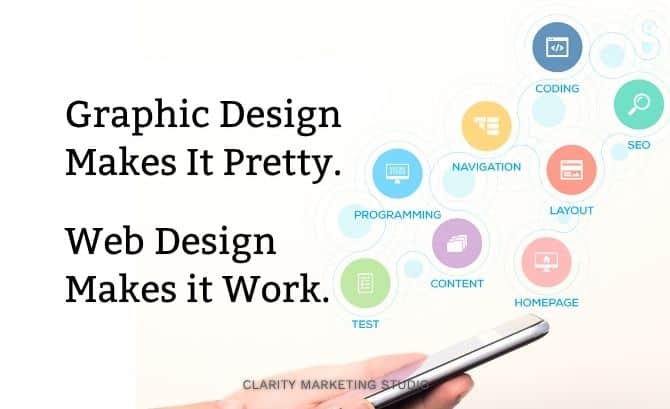
People expect a site to work immediately on any device, load in a couple of seconds, and answer their question before they bounce, because that’s what every other site they use has trained them to expect.
Search engines now weigh dozens of structural and technical signals before a site ever shows up in results. AI platforms are reading and summarizing sites in ways no one designed for a decade ago.
Web design has gotten dramatically more complicated even in the last few years, layered with changing technical, behavioral, and search requirements that simply didn’t exist before. Looking good is still important, but it’s now one job among many. Treating graphic design as the only job is how businesses end up with a gorgeous site that fails to intuitively assist visitors in their quest for information, and in the long run a site that quietly underperforms.
Why a Beautiful Website Isn’t Necessarily a Good Website
Graphic design uses color, type, photography, illustration, logos, shape, spacing, hierarchy, and brand standards to communicate a message and build a recognizable identity. It’s the discipline behind brochures, ads, social graphics, signage, and packaging. It’s a huge part of what makes a website feel polished and on-brand.
To be fair, graphic design has its own strategy. Choosing a color palette to evoke trust, choosing typography to signal premium versus approachable, structuring visual hierarchy to pull the eye toward a call to action. Brand strategy, color psychology, and audience perception are real strategic disciplines in their own right. So this isn’t a claim that graphic design has no strategy at all. It’s a narrower claim:
Graphic design’s strategy operates entirely within the visual and perceptual layer — how something looks, feels, and is perceived.
Web design’s strategy has to operate at a different layer altogether: how the site is organized, how visible it is in search, how clearly AI platforms can read it, how well it performs across devices, and how visitors turn into customers. And no amount of smart color or typography choices can solve for any of that.
But a website isn’t a static graphic. People don’t just look at it; they click, scroll, search, compare, and decide.
A page can look completely polished while still presenting the wrong information, in the wrong order, to the wrong audience. When that happens visitors don’t know what’s wrong. They just know that they aren’t connecting with your content and start doubting whether they’re going to find what they need on your site. And they’re not going to reach out to tell you that — they just leave.
Good-looking and good-performing are two different report cards. A website can earn an A on one and a D on the other without you knowing it just from looking at the design.
Why Website Strategy Comes Before Visual Design
Before anyone picks a color palette, a strategic website has already answered a set of questions:
- Who needs to find this site, and what are they actually searching for?
- What do they need to understand first?
- Which objections does the site have to answer before someone will trust it?
- What does the business need this site to accomplish?
- How will search engines and AI platforms interpret what’s on the page?
None of those are questions graphic design is built to answer — they’re not about color, type, or layout at all.
They’re about audience, intent, and trust. Answering them is what shapes the site, the navigation, the service pages, the headings, and the calls to action, the whole structure. The visual layer gets built inside that strategy, not the other way around.
The Difference Between Graphic Design and Strategic Web Design
Graphic design decides how something looks and communicates visually.
Strategic web design decides how a site works, for the people using it and the search engines and AI platforms trying to understand it, so the business behind it actually grows.
Graphic design is a visual discipline shaped by aesthetics: color, type, composition, brand style.
Web design is a visual discipline shaped by marketing, research, and behavioral strategy.
The visuals are just the outer layer of something bigger. Treat the two as the same thing, and you end up with a stunning homepage that still can’t connect with people, search engines, or AI discovery.
Design for the Customer, Not the Owner
Every website has to answer one question before anything else gets decided: who is this site actually for?
Is the site’s purpose to talk to potential customers, or is it really more about the owner than the audience? Those are two different jobs that call for two different structures.
Business owners naturally want to organize a site the way they think about their own company, leading with something personal, showcasing every service at once, giving top billing to whatever they personally care about most. That’s portfolio thinking, not customer thinking, and it puts the site to work for the wrong audience.
Visitors don’t think that way. They’re asking practical questions: Am I in the right place? Does this understand my situation? Can I trust these people? What makes this option different? What do I do next? Good web design organizes the entire experience around those questions, not around what looks most interesting on a screen.
The homepage especially shouldn’t be a highlight reel of favorite design elements; it should move someone from recognition, to understanding, to proof, to action. Graphic design has no way to correct for this on its own.
The job of graphic design is to make whatever gets prioritized look good, not to question the priority itself.
Relying on graphic design alone can result in a site that satisfies the owner, but doesn’t work for visitors. The owner’s personal story or pride behind it means nothing to someone who doesn’t share the same attachment. What feels significant to the owner can be completely unrecognizable, and forgettable, to everyone else.
A Website Is a Marketing System, Not a Graphic
A single page rarely does all the work, but graphic design doesn’t account for that. Its instinct is to treat every page as its own self-contained piece, the same way a flyer or an ad is meant to work alone.
A real website strategy sees the whole picture: core service pages, location-specific information, helpful blog content, FAQs, case studies, reviews, and links from other credible sites — all connected on purpose, not just published side by side.
Content and design aren’t two separate jobs. The message and the structure determine which point goes first, where proof needs to show up, when to introduce a service, how much someone needs to understand before they see a call to action.
Move that order around and you can quietly weaken the whole system, even while every individual page still looks great in a screenshot.
Graphic Design Has One Audience. Web Design Has Three.
Graphic design was built to speak to one audience: the human eye. It’s very good at that.
But a website has three audiences to satisfy, and two of them can’t see a color palette or a clever layout at all.
The humans visiting it need to move from confused to confident, to understand who you are, whether you’re a fit for what they need, and what to do next. Graphic design has real strategy for this audience: color psychology to build trust, typography to signal tone, visual hierarchy to guide the eye toward what matters. It can make that experience feel good. What it can’t do is decide what information those humans need or in what order. That’s a different kind of strategy that visuals alone can’t supply.
The search engines need the site built clearly enough for them to read it, understand it, and match it to what people are actually typing in. A search engine can’t appreciate a beautiful layout. It reads code, headings, and text, and if the important information only lives inside a graphic, it’s invisible to search entirely.
The AI platforms need the content laid out clearly enough to summarize it, reference it, and recommend you when someone asks an AI tool a question instead of typing it into Google. Like search engines, AI platforms work from the actual content on the page, not the impression it makes. A gorgeous, image-heavy page with very little real text can look perfect to a person and tell an AI system almost nothing about your business.
Graphic design has a real answer for the first audience and no answer at all for the other two.
That gap is exactly what web design strategy has to fill. Get all three right, and the business result takes care of itself. Visits turn into leads, calls, tours, or bookings, reliably instead of by accident.
A Website Isn’t a Digital Brochure
Graphic design’s instincts come from print, where a brochure is fixed and meant to be read start to finish, in one order. A brochure is a static product.
But people don’t read web pages from top to bottom — they scan.
Print graphics are generally crated to be read in a fixed order from top to bottom.
Web design has to produce a fluid experience that’s scannable, interconnected, and web-like to quickly and intuitively get them to the information they’re looking for.
One visitor lands on the homepage. Another searches Google and drops straight onto a service page. Someone else finds a blog post through an AI platform, or a link a friend shared. Each visitor arrives on a different device, looking for different information, at a different point in deciding whether to trust you.
The site still has to help every one of them answer the same handful of questions: Where am I? What do you offer? Does it fit what I need? Can I trust you? Where do I go for more? What do I do next? That takes real thought about how the content is organized and connected, something graphic design’s brochure instincts were never built to handle.
Web Design Has SEO Structure. Graphic Design Doesn’t.
Color, type, and layout have nothing to say about which pages should exist, what they should be named, or how they should connect to each other.
SEO simply isn’t part of graphic design’s vocabulary.
Search visibility comes entirely from how a site is structured, and that structure has to be decided before the visual design even starts, not layered on top once it’s finished.
Which services get their own page, how navigation is organized, how headings describe content, how pages link to each other, where location information lives, how fast pages load, how well the site works on mobile. Every one of these is a web design decision with real SEO consequences, and graphic design has no mechanism for making any of them.
For example: a homepage’s job is to introduce things at a high level, in the order people actually need them: what you do, who you’re for, why you’re credible, what to do next. Not to say everything at once.
Graphic design has no sense of that order. It doesn’t know what belongs at the top versus further down, or what should get a brief mention here and a fuller explanation somewhere else. Left to its own instincts, it treats the homepage as the whole story instead of the front door, which is exactly how every service ends up crammed into one laundry list there, all competing for the same few seconds of attention instead of guiding someone toward what they actually came to find out.
Deciding what belongs on the homepage, and what gets introduced later, is strategy, not a layout decision.
Web Design Speaks to AI Platforms. Graphic Design Doesn’t.
More people are turning to AI tools and AI-generated search results to research businesses and compare options before they ever visit a site directly. Graphic design wasn’t built for this audience — it was built to be read by a human eye, and AI platforms don’t have one. Those systems have to understand your content before they can accurately summarize, reference, or recommend you, and no amount of visual polish helps them do that.
A well-built site helps by explaining, clearly and specifically, what you do, who you serve, where you operate, what makes you different, and what experience backs up your claims. Focused service pages, genuinely useful articles, FAQs, and clear links between pages all give AI systems something real to work with.
A dramatic but generic headline like “Imagine What’s Possible” might land visually in a graphic design, but it tells an AI platform and a lot of human visitors almost nothing.
A more specific message can still have personality while giving people, search engines, and AI something real to understand.
Web Design Works on Every Screen. Graphic Design Wasn’t Built To.
Graphic design usually starts with a fixed canvas with set dimensions, and once it’s approved, it looks the same everywhere it’s printed or posted.
Websites don’t get that luxury. The same site gets viewed on a desktop monitor, a tablet, a laptop, and a phone held in one hand, and it has to hold up on all of them without losing clarity or function — something a fixed-canvas discipline was never built to plan for. Text has to stay readable. Buttons have to stay easy to tap. Navigation has to keep making sense.
Graphic design can make one version of a page look stunning on a large screen, but it has no way of knowing whether that same layout still works on a phone. And for most local businesses, a majority of visitors are arriving on a phone.
Web design strategy actually accounts for the whole experience, across every device someone might use, instead of just the one screen a design happened to look best on.
Web Design Delivers Performance. Graphic Design Doesn’t.
Big images, elaborate animation, and complicated layouts can look impressive and still slow a site down or make it harder to use. People are increasingly impatient with a slow or confusing site.
If a page is sluggish or hard to navigate, visitors leave before they ever see the message the design was meant to send.
Search engines notice too, favoring sites that deliver a fast, accessible experience, especially on mobile.
None of this exists in graphic design’s world at all. A brochure doesn’t have a load time. A print ad doesn’t need to work with a screen reader or a keyboard instead of a mouse. Speed and accessibility are entirely web design problems, and ignoring them doesn’t make them disappear, it just hands them to the visitor instead of the designer.
The same goes for the parts that never show up in a graphic design at all: color contrast, text size, keyboard navigation, and clear link labels determine whether real people, with real differences in ability and device, can actually use your site. Forms need to submit. Links need to work. Booking and scheduling tools need to be simple. None of this is a technical afterthought bolted on after design. It is the design. Because a beautiful page that stops someone from completing a task isn’t a successful design, no matter how it looks in a screenshot.
What Graphic Design Alone Cannot Do for Your Website
None of this is a knock on graphic design’s own strategy. Everything graphic design adds to a website is important, too. Color psychology, typography, and visual hierarchy are real strategic tools, and a designer who understands them is doing valuable work. It’s just work that stays inside what something looks and feels like. That’s not where the rest of a website’s job gets done.
Graphic design can’t tell search engines which of your pages matters most. It can’t tell an AI platform what makes your business different. It can’t organize your services into a structure people and search systems can both follow, and it can’t get a slow, confusing, or inaccessible site to actually turn visitors into customers. That gap carries a real cost.
A pretty site with no strategy behind it rarely fails loudly. It just quietly underperforms, month after month.
Visitors show up and leave without becoming a lead. Pages don’t rank in search results because no one ever decided what each page needed to say or to whom. AI platforms skip right past the business because there’s nothing solid on the site to reference. It still looks great in a proposal or a screenshot. It just never had what it needed to work.
Most people don’t know how to make good website decisions, and there’s no reason they should, when discussions like this are far from their wheelhouse. So it’s easy to default to what’s easiest to judge: how pretty a design portfolio looks. Most business owners won’t know how to judge whether a site will actually generate leads, rank in search, or hold up as a marketing system until it’s too late. The beauty of a pretty design fades quickly for business owners later realizing their site isn’t capable of doing its job for them.
What graphic design can do is make a strategically built site feel credible, consistent, and inviting once everything else is already working.
The real relationship between graphic design and web design runs in one direction.
Strategy and content come first, and graphic design follows — by illustrating and reinforcing the message rather than inventing it.
We don’t write content to fit a graphic design. We design around the content, because the content is what’s actually doing the work of convincing someone. Graphic design doesn’t decide what the website has to accomplish. It decides how to make that accomplishment look like it means it.
Graphic design determines how a website looks.
Web design determines what and how it communicates, how it responds, how it works, and whether it gets found. That’s the whole difference, and it’s why a website built on strategy will keep outperforming one built on looks alone, long after the first impression fades.
If you’re not sure whether your current website is built on strategy or just good looks, that’s exactly the kind of thing we look at with all our service business clients every day. Let’s talk about what yours needs to accomplish.
About the Author: Linda Phillips Blue
